RF-star, a leading global manufacturer of wireless modules, announces the upcoming release of its highly anticipated RF-TI1354P1 Wi-SUN module. Scheduled for launch in August, this innovative module based on TI CC135410 SoC, is poised to empower large-scale IoT deployments with its multiprotocol, dual-band capabilities, catering to the growing demands of smart cities, smart energy, grid infrastructure and industrial IoT sectors.


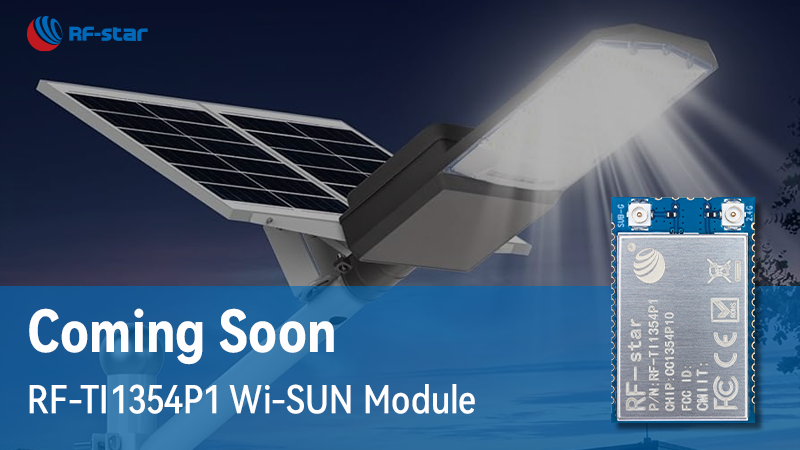
RF-TI1354P1 Wi-SUN Module Is Coming Soon

Figure 1 RF-TI1354P1 Wi-SUN Module Is Coming Soon

The RF-TI1354P1 module, promises to deliver a robust performance with wireless bands of 800 MHz - 928 MHz and 2.4 GHz. It can coexist and operate concurrently in multiple wireless stacks, eg. Bluetooth Low Energy 5.3, Matter, Thread, Wi-SUN, Zigbee protocol through a DMM driver.

Equipped with 1024 kB Flash and 288 kB RAM, the Sub-1GHz transceiver is designed to operate as a border router, extending its reach to up to 300 border router nodes. In a mesh network, each device can establish multiple and robust connections with nearby devices. Its self-healing and self-configuration capacities provide a more robust network and reduced downtime for the thousands of connected nodes. This feature is particularly advantageous for complex, distributed IoT applications that require extensive connectivity and reliable data transmission.

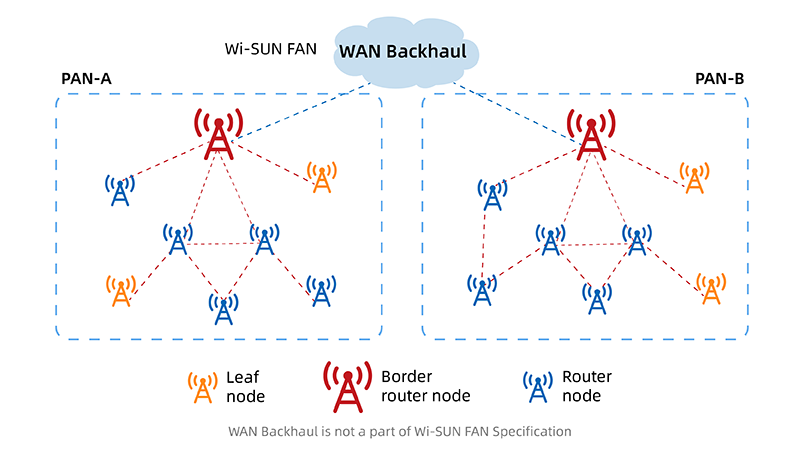
 Wi-SUN mesh network topology

Figure 2 Wi-SUN mesh network topology


“The introduction of the RF-TI1354P1 module marks a new era in IoT connectivity,” said Ben Qiu, GM of RF-star. “Its extensive nodes within a network will greatly enhance the scalability and flexibility of IoT solutions, making it ideal for smart city, grid infrastructures and industrial applications.”

The RF-TI1354P1 module is expected to build upon the success of RF-star's existing Wi-SUN modules, including the RF-SM-1277B1 and RF-TI1352P2, which have already established a strong reputation for their low power consumption, high data throughput, and ease of deployment. The new module's dual-band capability and extended node support will further solidify RF-star's position at the forefront of IoT wireless communication technology.


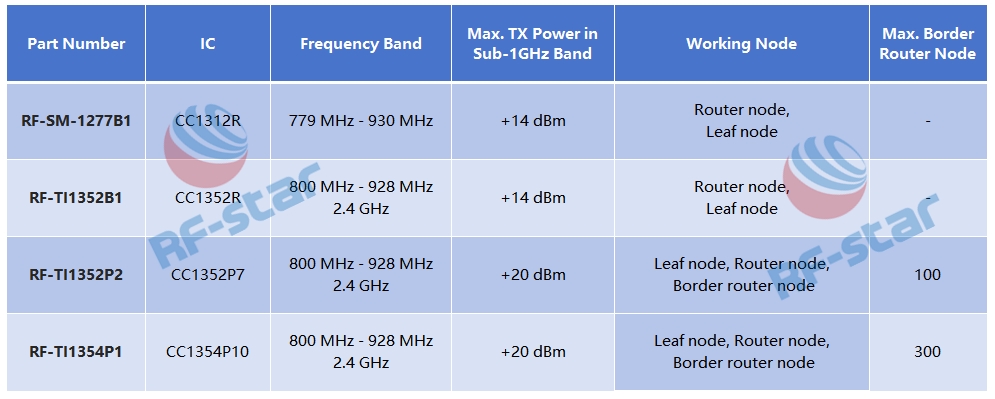
RF-star’s Wi-SUN Modules Support Border Router Node, Router Node, Leaf Node.

Figure 3 RF-star’s Wi-SUN Modules Support Border Router Node, Router Node, Leaf Node.


As the global Wi-SUN technology market is predicted to grow at a CAGR of 13.45% between 2024-2032, the RF-TI1354P1 module's release could not be timelier. It aligns with the market's shift towards more interconnected and intelligent systems, particularly in the realms of smart cities and energy management.

RF-star's dedication to innovation is evident in its development of high-performance Wi-SUN modules, which are set to empower a new wave of IoT applications. These advancements aim to enhance connectivity efficiency, reduce costs, and ultimately improve the user experience.

For more information on RF-star and its upcoming Wi-SUN module, please visit www.rfstariot.com

About RF-star

Shenzhen RF-star Technology Co., Ltd (RF-star) is a leading global provider of wireless communication modules and solutions, specializing in low-power modules for IoT, industrial, automotive, and consumer applications. With over a decade of expertise in Bluetooth and IoT communication technology, RF-star enriches smart life with reliable, secure, and intelligent wireless connectivity.

RF-star's product portfolio ranges from BLE modules, ZigBee modules, WiFi modules, Sub-1Ghz modules, Matter modules, Thread Modules, UWB modules and Wi-SUN modules, alongside customized services. As an official third-party IDH of TI and a trusted partner worldwide, RF-star is committed to delivering cutting-edge wireless solutions.

Rocky Mountain Conference on Magnetic Resonance(RMC)


It is our pleasure to invite you to the 63rd Rocky Mountain Conference on Magnetic Resonance(RMC) in beautiful Copper Mountain, Colorado.


It is EPR’s 80th birthday. We are celebrating the convergence of wisdom and innovation, the synergy between tradition and reinvention, and looking forward to being the meeting where young scientists new to EPR can meet giants of the field and in which the boundaries and scope of EPR is dramatically extended. EPR has so much to offer and so much to learn, and we aspire for this conference be the place where these conversations happen!


Meet us at Booth 12

Date: August 4 – August 8, 2024

Location:  Copper Conference Center in Copper Mountain, ColoradoRocky Mountain Conference on Magnetic Resonance(RMC)


Electron paramagnetic resonance (EPR) spectroscopy is a powerful experimental technique for studying paramagnetic species' electronic structure and properties. In EPR spectroscopy, the g-value plays a crucial role in understanding the behavior and environment of unpaired electrons in paramagnetic systems. This article aims to provide an overview of g-values and their significance in EPR spectroscopy.


1. Understanding the g-value:

The g-value, the spectral splitting factor or Landé g-factor, describes the relationship between the magnetic field and the energy levels of unpaired electrons in a paramagnetic system. It determines the resonant frequency of the EPR signal and can be used to identify and characterize paramagnetic species.


2. The g-value formula:

The g-value is calculated using the following formula:


g = (hf)/(μB * B)


where


g is the spectral splitting factor

h is Planck's constant

f is the EPR signal frequency

μB is the Bohr magneton (physical constant)

B is the strength of the applied magnetic field

The g value depends on the magnitude and direction of the applied magnetic field and provides information about the electronic structure and its interaction with the magnetic field.


3. Significance of g-value:

a. Identification of paramagnetic species: The g-value is unique for each paramagnetic species and can be used to distinguish between different species. By comparing the experimentally measured g-value to a reference value, scientists can identify unknown paramagnetic species.


b. Detecting the electronic environment: The g-value is sensitive to the local electronic environment around unpaired electrons. Factors such as coordination field, coordination geometry, and the spin density of the unpaired electrons all affect the g-value. Analyzing changes in the g-value can provide insight into the electronic structure of a system and its surrounding environment.


c. Study of electron delocalization: In systems with multiple interacting unpaired electrons, the g-value provides information about the degree of electron delocalization. larger g-values indicate a higher degree of electron spin localization, while smaller g-values indicate a higher degree of electron localization.


d. Quantification of Magnetic Anisotropy: The g value helps in determining the degree of magnetic anisotropy, which is the dependence of the magnetic properties of a system on the direction of the applied magnetic field. g deviates from the free-electron value (2.0023) indicating the presence of an anisotropic factor.


4. Factors affecting the g value:

Several factors affect the g value, including the nature of the paramagnetic center, the coordination environment, the presence of neighboring atoms or molecules, and the effect of spin-orbit coupling. These factors add to the complexity of interpreting EPR spectra and require careful analysis and theoretical calculations.


The g value plays a fundamental role in EPR spectroscopy, providing valuable information about the electronic structure, environment, and magnetic properties of paramagnetic species. By understanding the significance of the g-value and its relation to the applied magnetic field, scientists can gain insight into the behavior and properties of unpaired electrons, thereby facilitating the characterization and study of various paramagnetic systems.


Check more EPR-related application notes


Check CIQTEK EPR series products.

Contact: info@ciqtek.com or check the Contact Page to leave us a message

EPR spectroscopy

Paris, France - The Paris 2024 Olympics have arrived, and with them comes a revolutionary technology that is redefining the Games experience: RFID wristbands. These cutting-edge devices, powered by Radio Frequency Identification (RFID), are making a lasting impact in supporting diverse industry needs, driving technological innovation, and promoting sustainable development throughout the Olympic Games.


The Paris 2024 Olympics


From seamless access control to enhanced fan engagement,  RFID solutions have become an essential asset in ensuring the success and enjoyment of the world's most prestigious sporting event.


Enhancing the Olympic Experience: RFID wristbands have revolutionized the way attendees experience the Olympics. With touch-and-go convenience, visitors can effortlessly enter venues, navigate the Olympic Park, and access exclusive areas. Further, these smart wristbands enable cashless transactions, allowing spectators to make purchases with a simple tap, ensuring a smooth and secure payment experience

.
Empowering Athletes: Athletes are at the heart of the Games, and RFID wristbands have transformed their experience. By integrating these devices into their accreditation, training, and performance monitoring, your solutions provide invaluable insights into their health, habits, and performance. Real-time data collection empowers athletes and their coaches to gain a competitive edge, optimize training regimens, and elevate their performance to new heights.
Supporting Sustainable Operations: The Paris 2024 Olympics are committed to sustainability, and RFID solutions align perfectly with this vision. By eliminating the need for traditional paper tickets, reducing waste, and streamlining operations, RFID wristbands contribute to the Games' eco-friendly efforts. Additionally, these devices enable organizers to efficiently manage resources, monitor energy consumption, and minimize the event's environmental impact.


Technological Innovation: RFID wristbands represent a significant leap forward in technological innovation. Seamlessly integrated with state-of-the-art wireless connectivity and data analytics, these smart devices provide advanced insights into crowd movement, behavior patterns, and event logistics. By harnessing the power of real-time data, organizers can make informed decisions, enhance security, optimize operations, and create a truly immersive and unforgettable Olympic experience.


Olympic Spirit in Action:Just as the Olympic Games embody teamwork and determination, challenges need to be overcome to achieve excellence. The RFID infrastructure ensures seamless integration with existing systems, fully demonstrating the Olympic spirit of collaboration and determination.


Discover the potential of RFID wristbands in your projects and unlock a new realm of possibilities by contacting us today. Together, let us create a future where technology and sports converge to elevate human experiences and build a more connected world.


Smart coffee machine refers to the application of electronic technology in coffee machines. It is equipped with an intelligent control system and a touch-sensitive LCD screen to realize intelligent control of the entire coffee brewing process such as grinding, pressing, and boiling, brewing, cleaning residues, and supporting facilities. milk. Smart coffee machines brew coffee according to the most scientific data and procedures, and are equipped with a complete protection system. Only by using it in the correct way can users produce healthy and personalized coffee.


What functions can be achieved with the current development of smart coffee machines?

Design appropriate program settings using the touch screen UI:

For smart coffee machines, the program settings are generally the same, such as cup control, temperature control, pre-grinding function, coffee bean dosage adjustment, preset function, etc.


Digital smart touch:

Smart coffee machines are controlled by digital intelligence. The coffee machine LCD screen can display the working status at any time. The digital display will show what the coffee machine is preparing to do or what it is doing.


Newland AIDC, a leader in the field of automatic identification and data capture, proudly unveils its latest innovation – the NLS-FM3280. This two-in-one fixed mount barcode scanner is not just a leap forward in barcode scanning technology; it's a multifunctional marvel that integrates the convenience of Near-Field Communication (NFC) with superior barcode scanning capabilities. Designed to meet the evolving needs of diverse industries, the FM3280  stands out as a versatile and robust solution for data capture challenges.


  Enhanced Trial Reading Capabilities  

The FM3280 sets a new standard in barcode scanning, demonstrating unparalleled proficiency in reading both 1D and 2D barcodes. Its advanced scanning capabilities ensure quick and accurate data capture, a crucial factor in high-paced environments. Furthermore, its NFC functionality is a game-changer, seamlessly interacting with NFC cards and mobile phone NFC. Whether it’s traditional labels or digital formats like electronic QR codes, the FM3280 handles them all with ease, ensuring your business stays ahead in a digitized world.


  Advanced Specifications and Unparalleled Durability  

The Newland AIDC FM3280 embodies a perfect blend of advanced features and exceptional durability. Engineered for resilience, it boasts an IP67 rating, ensuring robust performance in diverse weather conditions and environments. This durability is further supported by high-temperature-resistant materials, guaranteeing reliability even in extreme settings.

The FM3280 marks a significant upgrade from its predecessor, the FM30. It introduces an enhanced interface and a high-resolution megapixel scanner, ensuring precision and efficiency in data capture. The integration of responsive IR sensors and light triggers facilitates ultra-fast scanning, adaptable to rapid movement and varied lighting conditions.

The design of the FM3280 prioritizes user convenience. Its installation process is streamlined, and compatible with the mounting positions of the FM3080, simplifying upgrades for existing users.

The FM3280 stands out as a versatile and reliable tool, ready to tackle the challenges of both bustling indoor environments and rigorous outdoor operations, embodying the technological prowess and customer-centric design philosophy of Newland AIDC.


  Versatile Applications and Interface Support  

The Newland AIDC FM3280 is engineered to meet the diverse demands of various sectors, including retail, security, access control, and self-service. Its versatility is largely attributed to its broad compatibility with multiple communication interfaces. Supporting USB, RS232, RS485, and Wiegand, the FM3280 integrates seamlessly into different technological ecosystems, showcasing unparalleled flexibility. This adaptability is crucial in addressing the unique requirements of each sector, ensuring the FM3280 is a fitting solution for a wide range of applications.


  Integration with N-ScanHub SDK  

Further enhancing its market readiness is the integration with N-ScanHub, Newland AIDC's advanced device management SDK. This integration is a strategic move towards simplifying both the integration and maintenance of the FM3280. By pairing with N-ScanHub, the device transcends being merely a scanning tool; it becomes a comprehensive scanning solution. This paves the way for smoother operation, easier management, and enhanced reliability, aspects that are vital in today’s fast-paced business environments.


  Targeted Market and Use Cases  

The FM3280 is designed with a clear understanding of market needs. It finds its place in access control systems, ticket inspection machines, and various self-service terminals like lottery machines, recycling cabinets, express cabinets, self-service coffee machines, ticket machines, and settlement terminals. Its broad application scope is a testament to its flexibility and advanced design.


  Paving the Way for Market Success  

The Newland AIDC FM3280 is more than just a barcode scanner; it's a testament to Newland AIDC's commitment to innovation and quality. It stands tall against competitors with its superior resolution, wider field of view, and unique wide voltage support. But the true strength of the FM3280 lies in the backing it receives from Newland AIDC's robust technological background and its expansive global service network.

This combination of advanced technology, versatility, and reliable support positions the FM3280 not just as a product but as a comprehensive data capture solution poised to redefine the standards in its domain.


Introduction

The digital revolution has brought the Internet of Things (IoT) into the fabric of our daily lives. Wi-SUN technology, celebrated for its robust performance and versatile applications, has become a favored option for large-scale IoT implementations. This article explores the Wi-SUN technology market, its main benefits, use cases and applications, and RF-stars implementation of Wi-SUN.

Wi-SUN Technology Market

Recent Wi-SUN Technology Market Research Report by Business Research Insight and Market Research Future indicate that the global Wi-SUN technology market, valued at USD 319.27 million in 2022, is predicted to reach USD 14.568 billion at a whopping 13.45% CAGR between 2024-2032. This surge is fueled by ongoing proliferation of smart meters, sensors, and IoT devices, as well as the accelerated digital transformation spurred by the COVID-19 pandemic. Notably, North America stands out as a region with significant adoption of Wi-SUN technology.
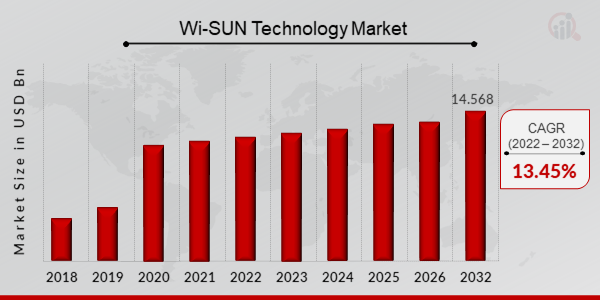
Wi-SUN Technology Market Size, 2023-2032

Figure1Wi-SUN Technology Market Size, 2023-2032 (USD Billion)

Source: https://www.marketresearchfuture.com/reports/wi-sun-technology-market-8695

Wi-SUN Overview

What is Wi-SUN?

Wi-SUN, or Wireless Smart Ubiquitous Network, is a wireless communication network based on the IEEE 802.15.4 standard. It delivers a high-performance, low-power, long-range, robust anti-interference, high data throughput, and highly secure wireless communication solution.

As a mesh network, it facilitates long-distance communication and high-data transmission between IoT devices through frequency-hopping and self-configuration technology. The network also features self-healing capability.

Wi-SUN: HAN vs. FAN

Wi-SUN supports two primary operational profiles: Home Area Network (HAN) and the Field Area Network (FAN):


  • HAN: Home Area Network HAN currently has several types, including Router B and enhanced HAN (supporting relay transmission). Router B refers to the Home Energy Management System (HEMS) controller, connecting smart appliances and smart meters. It enables real-time monitoring of smart appliance energy consumption and communication with FAN for smart city applications, enhancing the smart home environment.
  • FAN: Field Area Network Wi-SUN FAN is a mesh network where each device can establish multiple connections with nearby devices, scaling up to thousands of nodes. Each node provides typical long-distance hops. If an end-device fails to connect with another, it will automatically re-configure to an alternate path for other end-devices to the router node. This makes it ideal for large-scale infrastructure such as smart grids and streetlights. The Wi-SUN topology is illustrated below:
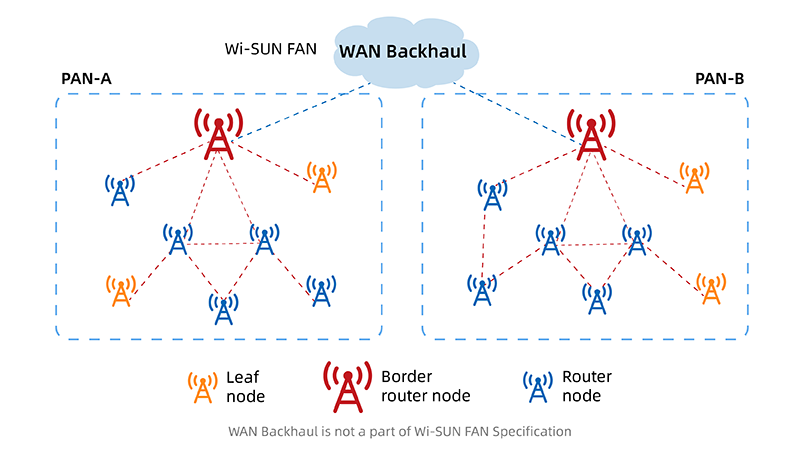

Wi-SUN network topology

Figure 2 Wi-SUN network topology

Benefits of Wi-SUN Network


  • Low Latency and High Data Throughput: Wi-SUN’s mesh topology, ensures a low-latency communication experience and supports high data throughput, catering to the demands of large-scale IoT deployments.
  • Low Power Consumption: Wi-SUN devices typically use battery power, significantly reducing energy consumption and extending device life.
  • Ease of Deployment and Scalability: Its straightforward network structure and support for self-forming networks make Wi-SUN an ideal choice for large-scale applications, with the flexibility to expand as the IoT ecosystem evolves.
  • High Security: Wi-SUN offers multiple layers of security mechanisms, such as advanced authentication, to ensure the safety of data transmission.
  • Interoperability: Based on the open standard IEEE 802.15.4, Wi-SUN supports data interoperability between end devices, enhancing overall network efficiency and application coverage.
  • Cost-Effectiveness: By integrating self-forming and adaptive frequency hopping technologies, Wi-SUN reduces overall costs, particularly suitable for in a wide range of IoT applications.
  • Wide Area Coverage: Using radio waves in the Sub-1GHz band (860MHz band, 920MHz band, and other bands below 1GHz), Wi-SUN offers longer reach and less radiofrequency interference with other electronic devices and obstacles. It is ideal for connecting utilities such as smart cities, smart homes, and energy management systems.


Wi-SUN Applications

Wi-SUN technology is finding its place in various global applications:

Smart Cities

Wi-SUN's long-distance transmission, scalability, bidirectional communication, and low power consumption have led to its deployment in many cities for smart meters and streetlights. For example, a Smart Cities Living Lab in Hyderabad, India, utilizes Wi-SUN mesh network technology to manage city assets efficiently.

Smart Streetlights

Wi-SUN technology supports large-scale outdoor IoT networks, including AMI metering and distribution automation, offering smart streetlight solutions for cities. In London, Wi-SUN mesh networks power streetlights, reducing maintenance costs and energy consumption while enhancing flexibility for aesthetic lighting and public safety.

Smart Meters

In smart cities, Wi-SUN technology enables real-time monitoring and management of electricity usage, optimizing energy distribution and reducing consumption.

Solar Power Plants

Wi-SUN networks allow for real-time monitoring of solar panel operations through intelligent monitoring systems, ensuring maximum power generation efficiency while minimizing environmental impact.

Smart Low Voltage Cabinets

In smart grids, Wi-SUN technology is used to deploy smart low-voltage cabinets, dynamically adjusting power supply and optimizing power distribution to enhance grid reliability and flexibility.

Industrial Facilities

Wi-SUN technology is also applied in the industrial and manufacturing sectors, providing non-proprietary solutions that make deployment more scalable, flexible, and secure.

RF-star Implementing Wi-SUN

As a global manufacturer of wireless modules, RF-star can supply a range of Wi-SUN modules based on TI CC1312 and CC1352 series chips.

Key Wi-SUN Modules

  • RF-SM-1277B1: Based on the CC1312R MCU, this low-power wireless module is designed for Sub-1GHz band from 779 MHz to 930 MHz.
  • RF-TI1352P2: Integrating a power amplifier, this module achieves a maximum transmit power of +20 dBm in the Sub-1 GHz band, offering a longer transmission distance and stronger penetration capability. Additionally, RF-TI1352P2 can operate in the 2.4 GHz band.

As shown below, the parameters of the Wi-SUN modules are listed:
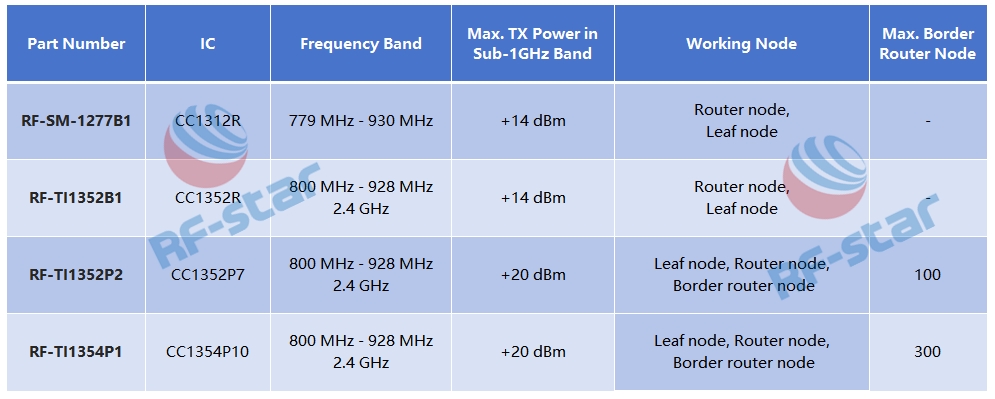
RF-star’s Wi-SUN Modules

Figure 3 RF-stars Wi-SUN Modules

Upcoming Releases

In August, RF-star is set to launch a new Wi-SUN module based on the TI CC1354P10 SoC. This module is expected to be a multiprotocol and dual-band 800 MHz - 928 MHz and 2.4 GHz wireless module with 1024 kB Flash and 288 kB RAM. Notably, the RF-TI1354P1 module can operate as a border router, extending up to 300 nodes. This will provide robust support for large-scale, distributed IoT complex applications. Stay tuned!

Conclusion

Wi-SUN's unique mesh network architecture, combined with its low latency, high data throughput, low power consumption, ease of deployment and scalability, high security, interoperability, and long-range transmission capabilities, makes it an ideal solution for wide-area large-scale IoT applications. As the market for Wi-SUN continues to expand, its applications in smart cities, smart energy, and industrial IoT are growing, showcasing its potential to enhance connectivity efficiency, reduce costs, and improve user experience. With manufacturers like RF-star leading the development of high-performance Wi-SUN modules, the future of large-scale distributed IoT deployments looks promising.
In today's fast-paced digital world, the need for efficient and secure charging solutions for laptops, tablets, and Chromebooks has never been more critical. Introducing the LVSUN 16-Port USB-C Charging Cabinet, a cutting-edge innovation designed to streamline your device charging experience while prioritizing safety and organization.

Efficiency at its Best: The LVSUN charging cart is equipped with 16 USB-C ports featuring PD3.0 technology, ensuring rapid and reliable charging for up to 16 devices simultaneously. Say goodbye to tangled cords and slow charging speeds - with this advanced solution, you can power up your modern laptops and tablets in a fraction of the time.

Smart Control at Your Fingertips: With the "innovatecharger" app, managing your charging schedule has never been easier. Whether you're in a classroom, hospital, warehouse, factory floor, or office, you can remotely control the charging process from your phone, optimizing efficiency and convenience.

Safety First: The LVSUN charging cabinet is engineered with your safety in mind. Featuring ventilation systems, ground fault protection, and rounded corners, this charging station ensures a secure and worry-free charging experience. The perforated door and vented side panels facilitate proper airflow to prevent overheating, while the secure locking mechanism provides peace of mind knowing your devices are protected.

Versatile and Organized: Designed with a large storage area and interior dividers, this charging station accommodates Chromebooks, laptops, tablets, and more with ease. The cabinet's 180-degree opening door allows for convenient access to your devices, making charging and storage a seamless process.

In conclusion, the LVSUN 16-Port USB-C Charging Cabinet offers a comprehensive solution for all your charging needs. Enhance efficiency, security, and organization in various settings with this state-of-the-art technology. Experience the future of charging with LVSUN.

Laser technology plays a crucial role in various industries, ranging from telecommunications to medical applications. To ensure the optimal performance and longevity of lasers, regular maintenance and repair are essential. In this article, we will delve into the world of laser repair, with a specific focus on large diameter fusion splicers and laser maintenance. We will discuss the importance of these devices, common issues faced during repair, and some best practices for effective maintenance.


Understanding Large diameter Fusion Splicers:

Large diameter fusion splicers are specialized tools used in fiber optic communication systems for splicing or joining optical fibers. These splicers facilitate low-loss connections between fibers, ensuring efficient light transmission. During laser repair, working with large diameter fusion splicers is crucial to maintain the integrity of optical connections.


Common Issues and Troubleshooting:
Fiber Alignment: Misalignment of fibers can lead to signal loss or degradation. During laser repair, precise alignment is essential. Technicians must ensure optimal fiber positioning using visual feedback or automated alignment systems.
Arc Discharge and Electrode Contamination: Arc discharge in fusion splicers can cause electrode damage and contamination, affecting the splicing process. Regular cleaning and replacement of electrodes are necessary for proper laser repair.

Fusion Splice Loss: High splice loss can occur due to improper fiber preparation, fusion chamber contamination, or misalignment. Accurate fusion parameters, clean splicing environment, and careful fiber handling are crucial to minimize splice loss.


Laser Maintenance Best Practices:
Cleaning Procedures: Regular cleaning of lenses, mirrors, and fiber connectors is crucial to maintain laser performance. Specialized cleaning solutions, lint-free wipes, and proper handli
ng techniques should be employed to avoid damage.
Power Calibration and Alignment: Periodic power calibration and alignment checks ensure accurate laser output. Technicians should follow manufacturer guidelines and use appropriate power meters and alignment tools for precise measurements.

Cooling System Maintenance: Lasers generate heat, and proper cooling system maintenance is essential to prevent overheating. Regular inspection, cleaning of filters, and monitoring coolant levels and flow rates are necessary for optimal laser performance.


Importance of Professional Assistance:

Laser repair and maintenance are intricate processes that require specialized knowledge and expertise. Seeking professional assistance from certified technicians or service providers ensures effective diagnosis, troubleshooting, and repair, leading to longer laser lifespan and improved performance.


Effective laser repair and maintenance are vital for maximizing the lifespan and performance of large core fusion splicers and lasers. By understanding the common issues faced during repair, implementing best practices for maintenance, and seeking professional assistance when needed, industries can ensure the reliable and efficient operation of their laser systems. Remember, regular upkeep and timely repairs not only save time and money but also contribute to the overall productivity and success of various industries relying on laser technology.